How Zoological Information Management Systems Support Global Species Databases
- By Species360

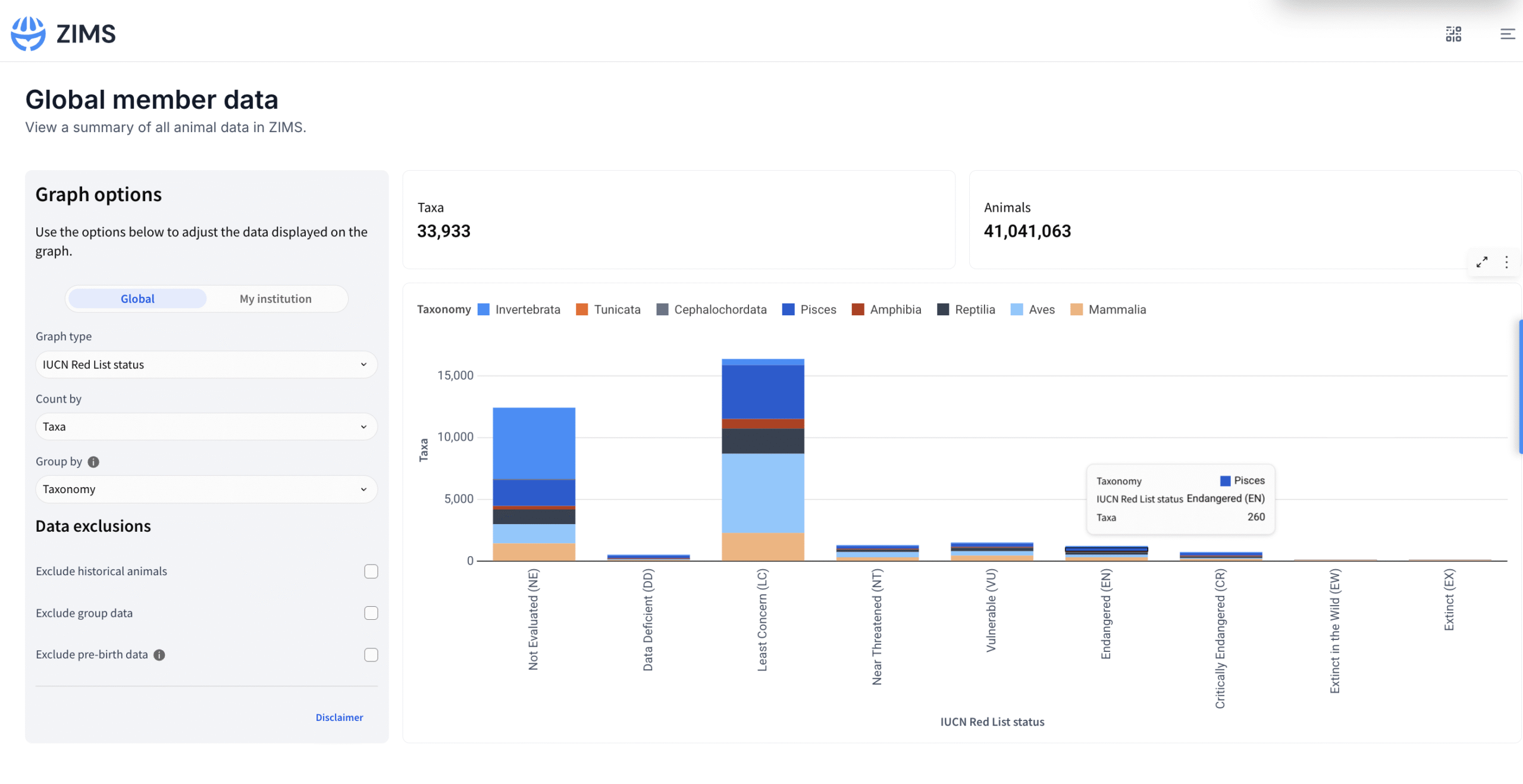
Modern wildlife conservation is increasingly data-driven. Institutions responsible for animals under human care generate vast volumes of information daily, including medical records, husbandry logs, behavioural observations, lineage updates, transfers, and regulatory documentation. Individually, these records support local operational management. Collectively, when structured and aggregated, they form the backbone of global species databases.
The strategic question facing zoo directors, registrars, and conservation leaders is not whether data should be collected. It is whether the infrastructure in place transforms institutional data into global conservation intelligence. A Zoological Information Management System provides the structural foundation required to achieve that transformation.
The Structural Problem: Fragmented Zoological Data
For decades, zoological institutions developed independent record-keeping practices. Even after transitioning from paper-based systems to digital files, fragmentation persisted. Different institutions used varying taxonomic references, inconsistent data fields, locally defined animal identifiers, and isolated databases.
This fragmentation produces systemic inefficiencies:
- Inconsistent species naming conventions
- Duplicate animal records across regions
- Incomplete transfer histories
- Inaccurate studbook contributions
- Inability to analyse health or demographic trends globally
At a local level, these issues may appear manageable. At a global scale, they undermine conservation modelling, genetic management, and epidemiological insight.
When data is not standardised, it cannot be reliably aggregated. When it cannot be aggregated, it cannot inform global decision-making.
From Record Keeping to Data Infrastructure
A Zoological Information Management System is not merely software for logging animal details. It is structured infrastructure designed to enforce data governance, taxonomy consistency, and interoperability across institutions.
Through the Zoological Information Management System, institutions contribute data into a unified global architecture that ensures:
- Controlled and standardised taxonomic updates
- Structured data fields aligned with international standards
- Unique global identifiers for individual animals
- Secure, role-based access controls
- Real-time synchronisation across member institutions
This structure enables a birth recorded in Johannesburg to integrate seamlessly with pedigree data in Berlin and population models in Washington. Consistency at the point of entry produces reliability at the point of analysis.
Why Standardisation Matters for Global Species Databases
Global species databases rely on cumulative accuracy. A single inconsistent field, such as a misrecorded parent ID or incorrect taxonomy update, may appear minor. Across thousands of records, these inconsistencies distort modelling outputs.
Standardisation delivers measurable advantages:
1. Reliable Population Demographics
Accurate birth, death, and transfer records allow demographic trend analysis across species. Directors can assess longevity patterns, reproductive success rates, and age distributions.
Without standardisation, these insights require manual reconciliation and often produce unreliable conclusions.
2. Epidemiological Surveillance
Shared medical coding and structured diagnostic entries enable cross-institution health trend identification. If morbidity rates increase for a particular species in multiple regions, structured systems surface patterns earlier.
Fragmented systems delay detection and weaken coordinated response.
3. Genetic Diversity Monitoring
Population viability modelling depends on precise lineage tracking. Aggregated, standardised records enable geneticists to calculate mean kinship, founder representation, and breeding recommendations with confidence.
Without structured data infrastructure, these calculations rely on reconciled spreadsheets that introduce human error risk.
Operational Efficiency at Institutional Scale
Directors evaluating system investment often focus on local operational value. However, global database integration also produces internal efficiencies.
Administrative Time Reduction
Manual duplication of records during transfers or studbook updates consumes staff time. A shared Zoological Information Management System reduces redundant entry.
Audit Readiness
Regulatory inspections and accreditation reviews require documentation transparency. Structured systems allow institutions to generate compliant reports quickly.
Reduced Data Loss Risk
Cloud-based infrastructure with role-based access controls prevents version conflicts, lost spreadsheets, and inconsistent backups.
Over time, operational efficiencies compound, reducing indirect administrative costs.
Financial Implications of Data Fragmentation
Fragmentation carries hidden financial consequences that are rarely quantified:
- Breeding misallocations due to inaccurate pedigree data
- Delayed transfers resulting in additional holding costs
- Grant rejections caused by incomplete population evidence
- Reputational risk affecting donor confidence
Conversely, participation in a structured global database enhances funding competitiveness. Many conservation grants require evidence of collaborative participation and data-backed management strategies.
Institutions aligned within a recognised Zoological Information Management System demonstrate infrastructure readiness, scientific credibility, and governance maturity.
Governance and Compliance Considerations
Global conservation operates within regulatory frameworks that include CITES reporting, national wildlife regulations, and accreditation requirements from associations such as WAZA and AZA.
A robust Zoological Information Management System supports:
- Export-ready regulatory documentation
- Traceable animal transfer records
- Historical lineage tracking
- Secure data governance aligned with institutional IT standards
Compliance failures can result in:
- Permit delays
- Breeding programme suspension
- Accreditation challenges
- Public scrutiny
Structured systems reduce these exposures by embedding compliance-ready documentation into daily workflow.
Common Institutional Mistakes in Global Data Strategy
Even institutions recognising the importance of shared databases often encounter strategic missteps.
Treating the System as an Optional Tool
When staff perceive the system as secondary to local documentation, parallel record-keeping emerges. This undermines data integrity.
Insufficient Training Investment
Data consistency depends on user competency. Without structured onboarding and continuous training, data field inconsistencies multiply.
Delayed Data Entry
Timeliness is critical for real-time modelling. Backlogged entries reduce predictive accuracy and compromise decision speed.
Weak Data Governance Policies
Taxonomy updates, access permissions, and data quality checks require defined oversight. Governance cannot remain informal.
Institutions that embed system usage into operational culture maximise long-term value.
The Strategic Importance of Network Effects
A global species database grows more valuable as membership expands. Each additional institution contributes data diversity, increasing modelling power and conservation intelligence.
Network effects produce:
- Stronger epidemiological trend detection
- More accurate demographic modelling
- Broader genetic diversity insight
- Enhanced collaborative research opportunities
Institutions outside structured networks risk informational isolation. Over time, this isolation weakens strategic positioning within conservation ecosystems.
Future Outlook: Predictive Analytics and Artificial Intelligence
Emerging technologies increasingly rely on structured datasets. Machine learning models require clean, standardised inputs to generate reliable predictions.
In the coming decade, structured zoological datasets may enable:
- Mortality risk prediction models
- Nutritional optimisation recommendations
- Behavioural anomaly detection
- Disease susceptibility forecasting
- Automated compliance monitoring
Institutions not participating in structured global systems will face barriers to adopting these predictive layers.
Data infrastructure decisions made today determine analytical capabilities available tomorrow.
Strategic Positioning for Institutional Leadership
For executive leadership and board members, investing in a Zoological Information Management System signals institutional maturity. It demonstrates:
- Commitment to international collaboration
- Alignment with conservation science standards
- Readiness for accreditation and compliance audits
- Long-term operational sustainability
In a sector increasingly evaluated on transparency and measurable impact, structured data participation enhances institutional credibility.
Risk Assessment: Choosing Not to Standardise
The risk of inaction is cumulative. Institutions operating on fragmented systems face:
- Increased administrative burden
- Higher compliance exposure
- Reduced competitiveness for collaborative grants
- Limited access to aggregated research datasets
- Isolation from global population modelling initiatives
Over time, these disadvantages compound, reducing strategic influence within conservation networks.
Conclusion
Global species databases depend on structured, interoperable, and standardised data ecosystems. A Zoological Information Management System transforms individual institutional records into collective conservation intelligence. It reduces fragmentation, strengthens compliance readiness, enhances operational efficiency, and unlocks predictive analytical potential.
For organisations committed to long-term species viability and global collaboration, structured data infrastructure is not optional. It is foundational.
To evaluate how integration into a unified global system can strengthen your institutional strategy and conservation outcomes, contact us to begin a structured discussion.

Effective conservation does not occur in isolation; it thrives through collaboration. Partnering with Species360 to aggregate global data on reproductive patterns and population dynamics is crucial for evidence-based conservation and the long-term sustainability of managed populations across institutions, maximizing global impact.
Maria Franke, Director, Applied Conservation, Toronto Zoo