Task Scheduling and Alerts in Animal Management Software
- By Species360

Effective conservation does not occur in isolation; it thrives through collaboration. Partnering with Species360 to aggregate global data on reproductive patterns and population dynamics is crucial for evidence-based conservation and the long-term sustainability of managed populations across institutions, maximizing global impact.
Maria Franke, Director, Applied Conservation, Toronto Zoo
The Operational Risk of Missed Actions in Animal Care
In animal care environments, failure rarely comes from a lack of expertise. It comes from breakdowns in execution.
A feeding delayed by two hours may not appear critical in isolation. A missed enrichment session may be rationalised as a one-off oversight. A late medication administration may be attributed to shift pressure. But animal care does not operate on isolated events. It operates on cumulative precision.
When these small failures stack, they create systemic instability.
The reality is simple. In environments where care is time-sensitive and condition-dependent, consistency is not a standard. It is a requirement.
Task scheduling and alert systems are designed to enforce that consistency at scale.
Why Static Scheduling Systems Fail Under Pressure
Most institutions begin with static scheduling tools. These include printed schedules, spreadsheets, or whiteboards that outline daily responsibilities.
These systems provide structure, but they are fundamentally passive.
They do not adapt to change. They do not notify staff when priorities shift. They do not track completion in real time. They assume that once a task is written down, it will be executed correctly.
That assumption breaks under real conditions.
Schedules become outdated within hours due to:
- Changes in animal health status
- Environmental disruptions
- Staffing constraints
- Unexpected operational demands
Without dynamic adjustment, static schedules create a false sense of control. Tasks appear organised, but execution drifts.
The Transition to Dynamic Task Management
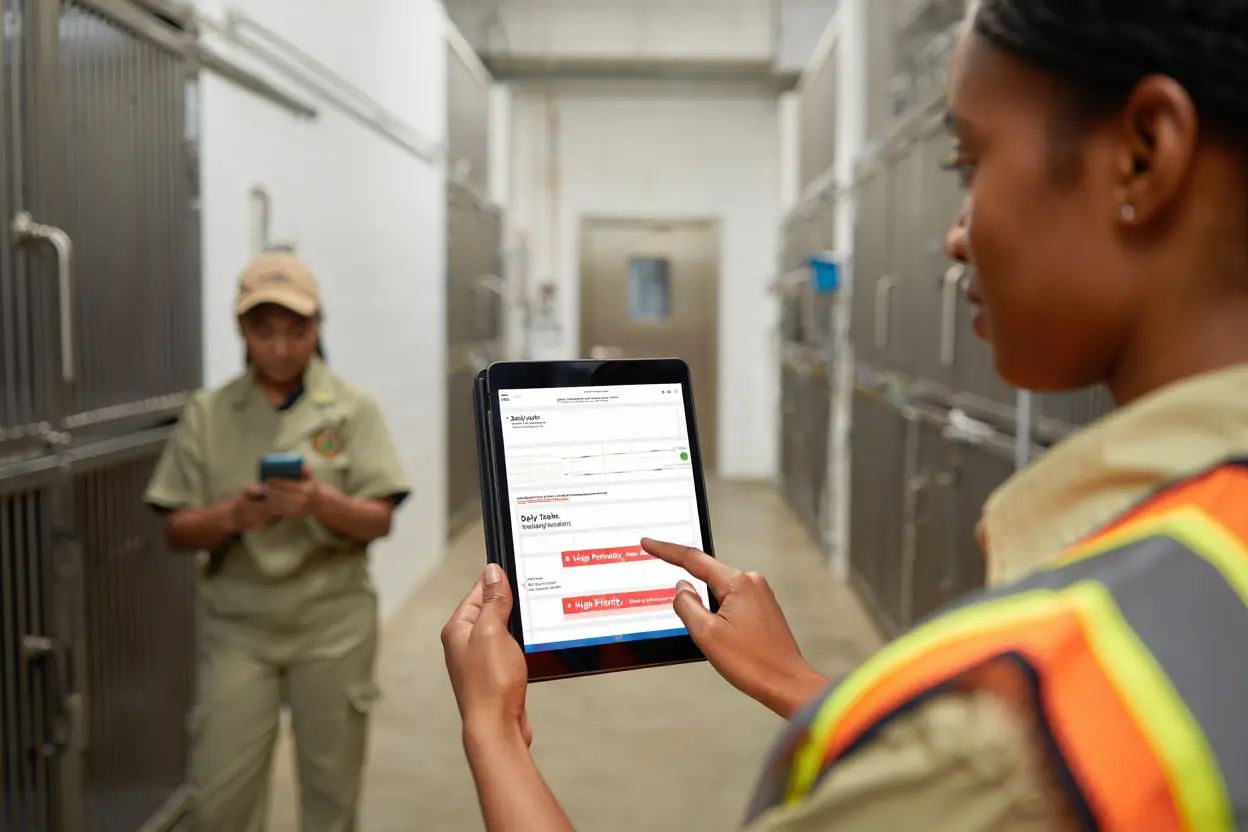
Animal management software transforms scheduling from a static plan into an active system.
Tasks are not simply listed. They are:
- Assigned to specific individuals
- Time-bound with defined windows
- Connected to relevant animal records
- Updated dynamically based on changing conditions
This creates a living schedule.
If an animal requires additional monitoring, tasks can be adjusted immediately. If a procedure changes, the system reflects it across all relevant workflows. If a staff member is unavailable, responsibilities can be reassigned without losing visibility.
This level of responsiveness is not an enhancement. It is necessary in environments where conditions evolve throughout the day.
Platforms built for this purpose, such as structured animal management software, embed scheduling directly into operational workflows, ensuring that tasks are continuously aligned with real-world conditions rather than fixed assumptions.
Alerts as an Enforcement Mechanism
Scheduling defines what should happen. Alerts ensure that it does happen.
Without alerts, schedules rely on human attention. Staff must remember to check systems, monitor time, and track multiple responsibilities simultaneously.
In high-pressure environments, this leads to missed actions.
Alerts introduce an active layer of enforcement.
They can be configured to:
- Notify staff before a task is due
- Trigger reminders at critical time thresholds
- Escalate if a task is not completed within a defined window
This creates redundancy in execution.
A task is not dependent on a single point of failure. If it is missed initially, the system intervenes. If it remains incomplete, it escalates.
This layered approach significantly reduces the likelihood of critical tasks being overlooked.
Building Accountability Into Daily Operations
One of the most significant advantages of integrated scheduling systems is the visibility they create.
Every task within the system carries:
- A defined owner
- A scheduled time
- A completion status
- A time-stamped record of execution
This removes ambiguity.
Management no longer needs to infer whether tasks were completed. The system provides direct evidence.
This visibility supports operational improvement.
Patterns begin to emerge. Bottlenecks can be identified. Repeated delays highlight areas where processes or staffing need adjustment.
Accountability is no longer enforced through supervision alone. It is embedded within the system itself.
Coordinating Across Shifts Without Information Loss
Shift changes are one of the highest-risk points in animal care operations.
Information is transferred between teams, often verbally or through incomplete documentation. Critical details can be lost, misinterpreted, or delayed.
Scheduling and alert systems reduce this risk by maintaining continuity within the system.
Tasks that span shifts remain visible. Incomplete actions are flagged. Alerts ensure that incoming staff are aware of pending responsibilities.
This eliminates reliance on memory or informal communication.
Instead of transferring information between individuals, the system carries it forward.
Managing Complexity at Institutional Scale
As facilities grow, the volume of tasks increases exponentially.
A small team managing a limited number of animals can operate with informal coordination. A large institution cannot.
Complexity introduces:
- Overlapping responsibilities
- Increased risk of duplication
- Higher probability of missed tasks
Animal management software absorbs this complexity.
It allows institutions to:
- Manage large task volumes without losing control
- Coordinate across departments and locations
- Maintain consistent standards despite scale
This scalability is essential for organisations planning expansion or managing multiple sites.
Risk Reduction and Regulatory Compliance
Animal care is subject to regulatory oversight. Compliance depends on consistent execution and accurate record-keeping.
Missed tasks or incomplete documentation can lead to:
- Audit failures
- Legal exposure
- Reputational damage
Scheduling and alert systems mitigate these risks.
They ensure that:
- Required tasks are completed on time
- Records are captured systematically
- Audit trails are available for review
This transforms compliance from a reactive process into a built-in operational feature.
Financial Impact of Scheduling Inefficiencies
Inefficiencies in task coordination rarely appear as direct costs. They manifest indirectly through wasted time, duplicated effort, and error correction.
Poor scheduling leads to:
- Overtime caused by misaligned workloads
- Redundant tasks performed by multiple staff members
- Delays that require corrective action
Structured scheduling systems reduce these inefficiencies.
By aligning tasks with available resources and enforcing execution timelines, organisations can optimise labour utilisation.
Over time, this creates measurable financial benefits.
More importantly, it allows institutions to scale operations without proportionally increasing staffing costs.
Where Scheduling Systems Fail in Practice
Despite their potential, not all scheduling systems deliver results.
Common failure points include:
- Overly complex interfaces that discourage daily use
- Lack of real-time updates, leading to outdated information
- Poor integration with other operational systems
- Insufficient training, resulting in partial adoption
When these issues occur, staff revert to informal processes. The system becomes secondary, and its value is lost.
Effective implementation requires more than software. It requires alignment with how work is actually performed on the ground.
From Reactive Scheduling to Predictive Coordination
The next evolution of scheduling systems is predictive.
As historical data accumulates, systems can begin to anticipate needs.
Patterns in task completion, animal behaviour, and environmental conditions can inform future schedules. Tasks can be optimised for efficiency and effectiveness.
For example:
- Feeding schedules can adjust based on observed consumption patterns
- Monitoring frequency can increase automatically for at-risk animals
- Staffing allocations can be optimised based on workload trends
This moves scheduling from a reactive process to a proactive strategy.
Institutions that leverage these capabilities gain a significant operational advantage.
The Strategic Role of Scheduling in Organisational Performance
Task scheduling is often viewed as an administrative function. In reality, it is a core driver of operational performance.
It determines:
- Whether critical tasks are completed on time
- How efficiently staff are utilised
- How effectively information flows across teams
When scheduling fails, the entire system becomes unstable.
When it is executed correctly, it enables consistency, scalability, and control.
Animal management software elevates scheduling from a static tool to a dynamic operational system that supports both daily execution and long-term strategy.
Conclusion
In animal care environments, consistency is the foundation of quality.
Task scheduling and alerts ensure that consistency is maintained, even as complexity increases.
By transforming static schedules into dynamic systems, animal management software reduces risk, improves accountability, and enables organisations to operate at scale without losing control.
The institutions that invest in these systems are not simply improving efficiency. They are building operational resilience.
To understand how advanced scheduling systems can be implemented within your organisation, the next step is to contact us and explore how structured coordination can transform daily operations.