Back to the wild: Golden Lion Tamarins triumph over international trafficking
Recently, in a protected stretch of Brazil’s Atlantic Forest, four small, flame-coloured primates began a new life. Four endangered golden lion tamarins (GLTs) seized by the Brazilian government from international traffickers in 2023 and 2024 were released in their native Atlantic forest in the Municipality of Macaé, Rio de Janeiro, Brazil, on 8 August.

The rescued GLTs released last week are two male-female pairs. A field team will monitor how they are coping back in their natural environment until each pair establishes their own home territory. The technical work of selecting the individuals to be returned to the wild and the definition of the protocols for the process were carried out by specialists who are part of the National Action Plan for the Conservation of Atlantic Forest Primates and Maned Sloths, coordinated by the Brazilian government (The Chico Mendes Institute for Biodiversity Conservation, or ICMBio).
Andréia Martins, Coordinator of the Golden Lion Tamarin Association Field Monitoring Team said; “This is an amazing story of the endurance of these tiny monkeys and a truly global effort to ensure their survival. On 8 August, we returned two GLT pairs to their native Atlantic Forest, giving them a second chance to help assure a future for their species.”
The Role of Data in Ensuring a Successful Release
Rescuing the tamarins was only the first step. The next challenge was a complex puzzle: how to form healthy, genetically strong pairs from a group of individuals whose family relationships were unknown after the trauma of trafficking. This is where a global team of experts and powerful data tools came in.
This release was truly a global effort, backed by scientific data and analytical tools via the Species360 Zoological Information Management System (ZIMS) and the Species Conservation Toolkit Initiative (SCTI).
Brazil’s National Action Plan for the Conservation of Atlantic Forest Primates and the Maned Sloth and the associated Population Management Program (PMP) for golden lion tamarins, calls for an ex situ insurance population for golden lion tamarins. The global ex situ program is run under the auspices of the National Center for Primate Research and Conservation, of Brazil’s Chico Mendes Institute for Biodiversity Conservation (ICMBio) (i.e. the Brazilian Government).
This population is managed through a WAZA International studbook dataset kept in ZIMS for Studbooks, with regional coordinators in Brazil (ICMbio with the Brazilian Association of Zoos and Aquariums), North America (Association of Zoos and Aquariums), Europe (European Association of Zoos and Aquaria) and Australasia (Zoo and Aquarium Association). These coordinators maintain the data for their region’s data, and each region uses the analytical software package PMx from the Species Conservation Toolkit Initiative (SCTI) to make their own breeding and transfer recommendations.
Dr. Kristin Leus, from Copenhagen Zoo, has multiple roles, but in the case of the golden lion tamarins, she is the Global Population Biologist, analysing the global metapopulation data and working with the regions and International Studbook Keeper to assess and plan for interregional transfers, so that the global population meets the demographic and genetic targets set for it in the Population Management Plan (PMP).
Using PMx for Population Modelling
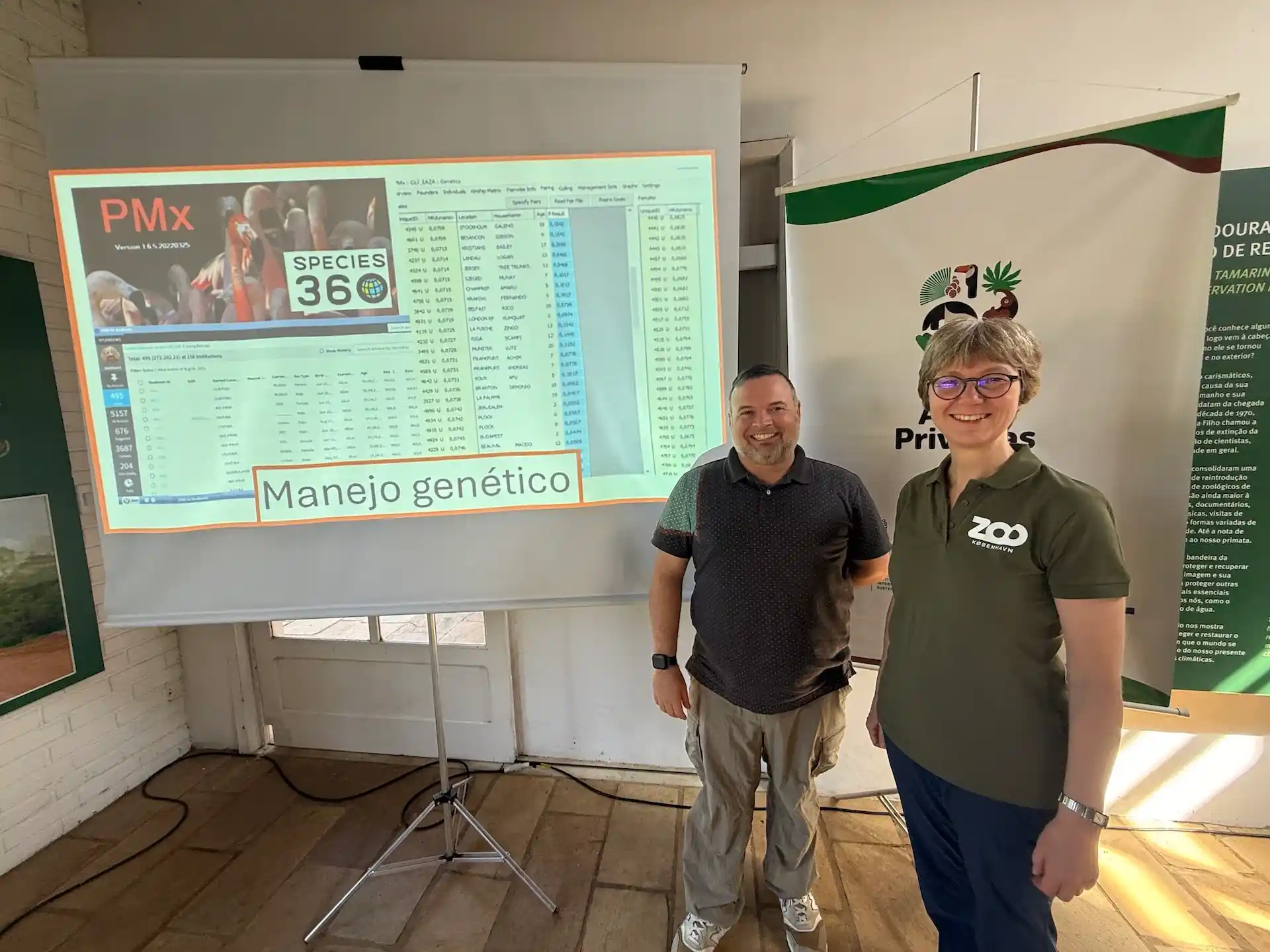
For this release of trafficked GLTs, Dr. Leus and her colleagues used the population modelling software PMx by SCTI to determine which male-female pairs would, from a genetic point of view, best be formed out of all the available golden lion tamarins that were confiscated in Suriname and Togo.
She used empirical kinship values, derived from molecular data, to account for genetic relationships among confiscated individuals. While such relationships in PMx are typically calculated from pedigree data, integration of empirical kinships is a newer feature for populations with insufficient or unknown pedigree, providing the ability to replace or combine kinship values derived from a pedigree with those derived molecularly. In this case, poor conditions during capture and transport often break up wild family groups, making relationships otherwise impossible to discern.
Using the PMx management sets tab, she identified the optimal number and combination of pairs that would provide the greatest genetic benefit to the wild. This included pairing individuals with minimal relatedness and maximizing the genetic diversity represented among them.

We used PMx to determine, out of all the available individuals, which pairs would be best formed. This ensures we are returning the greatest possible genetic diversity back to the wild population, giving them the best chance to thrive
Dr. Kirsten Leus, Copenhagen Zoo, Global Population Biologist
Of course, genetics was not the only criterion, Dr. Leus and her team also looked at the age and general health and physical state of the individuals, to make sure they release individuals that have a good chance to survive and breed in the wild.
And improtantly, this was team work. She worked together with the Brazilian coordinator, Mara Cristina Marques based in Zoo São Paulo; the colleagues of the two zoos where the animals are living now to recover from their trafficking ordeal; Silvia Bahadian Moreira of the Rio de Janeiro Primatology Center and Claudia Igayara of the Guarulhos Zoo in Sao Paulo; and Andrew Baker, a colleague from Save the Golden Lion Tamarin (SGLT) and the Golden Lion Tamarin Association, (Associação Mico-Leão-Dourado – AMLD) who shared helpful insights learned from earlier experiences with translocations of wild and zoo-born GLTs.
This collaborative, data-driven approach ensured that the released tamarins were not only genetically valuable but also physically prepared for life in the forest.
GLT Iconic Conservation Success Story
Golden lion tamarins are threatened with extinction and are endemic to the Atlantic Forest, more precisely to the lowland forests of the interior of the Brazilian state of Rio de Janeiro. A world-famous conservation program for the species coordinated by the Brazilian government — ongoing for more than 40 years with the involvement of many national and international organizations — increased the wild GLT population from 200 to 4,800 today.
These conservation efforts included translocations of wild and zoo-born GLTs – expertise that could be relied on for planning today’s release. About 150 zoos and aquariums in Brazil and around the world participate in an effort that maintains a genetically diverse insurance population capable of providing GLTs for translocation should a disaster reduce the wild population. Illegal capture for the international pet trade has long been one of the causes of this species’ endangered status. However, the intense conservation effort in recent decades significantly reduced this activity.
A mighty team effort
Watch the moment as the golden lion tamarins are released into the Atlantic forest, Brazil. Video Credit: Luiz Thiago de Jesus/AMLD.
The four GLTs returned to the wild were part of 2023 and 2024 rescue operations. The effort to return the GLTs to the wild is a collaboration of many institutions:
- Seizure of trafficked GLTs: Brazilian Federal Police, the Brazilian Institute of the Environment and Renewable Natural Resources (IBAMA).
- Care and return to Brazil of the GLTs seized in Togo and Suriname: Brazilian Ministry of Foreign Affairs, Brazilian Ministry of the Environment, Brazilian Institute of the Environment and Renewable Natural Resources (IBAMA), Chico Mendes Institute of Biodiversity Conservation (ICMBio), Brazilian Federal Police, Freeland Brazil, Callitrichid Taxon Advisory Group of the European Association of Zoos and Aquaria (EAZA).
- Animal care in Brazil and preparation for release: Rio de Janeiro Primatology Center of the Rio de Janeiro State Environment Institute (INEA), Golden Lion Tamarin Association (AMLD), National Center for Primate Research and Conservation/ICMBio, Copenhagen Zoo, Species360, Guarulhos Municipal Zoo, and Zoo São Paulo.
- Release and monitoring: Golden Lion Tamarin Association (AMLD), Universidade Estadual Norte Fluminense (UENF), Municipality of Macaé.
For more information on Save the Golden Lion Tamarin, please visit the website here: www.savetheliontamarin.org
Press release text about the GLT release was supplied by Save the Golden Lion Tamarin.