Introducing the speakers for the 3rd Annual Species360 Conservation Science Alliance Research Symposium
- By Gavrielle Kirk-Cohen
Join us on 29 July for the zoo and aquarium research event of the year!
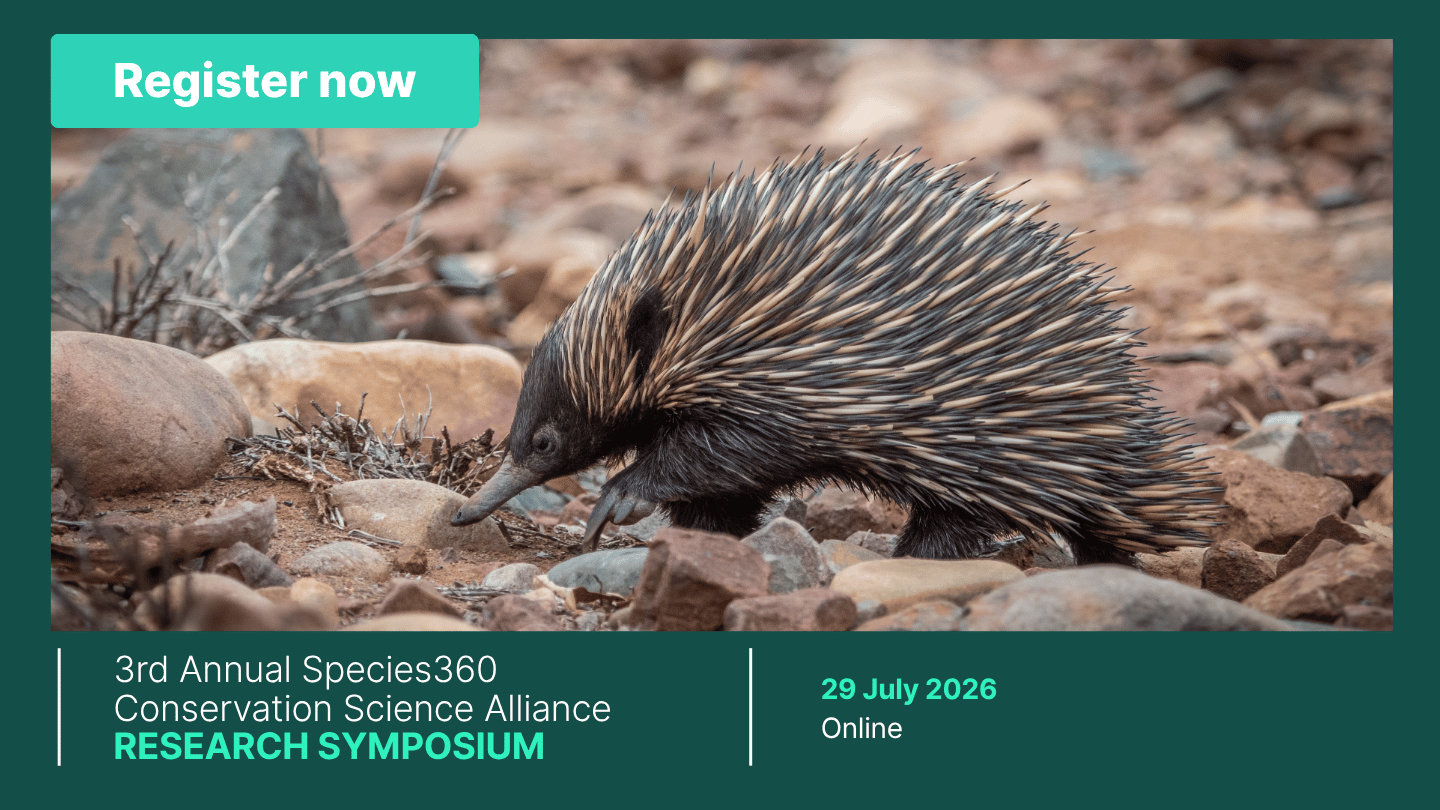
We’re pleased to announce the speakers for the upcoming 3rd Annual Species360 Conservation Science Alliance Research Symposium. This year’s talks showcase the breadth of insights that aggregated data from the Species360 Zoological Information Management System (ZIMS) can produce, with presentation topics including post-release health monitoring in echidnas, life expectancy and welfare in zoo-housed elephants, the effects of latitudinal displacement on carnivore reproduction, and more.
This year’s symposium, to be held online on 29 July, brings together researchers from around the world who are using shared global wildlife data from ZIMS to tackle pressing questions in animal health, wildlife demographics, and conservation.
The event is free to attend. Please register through the link below.
Event Details
When: 29 July 2026
Time: 4pm CET / 9am CDT (check the time in your region here)
Register here: bit.ly/3QG2Jll
Speakers and presentation topics
- Health assessment and post-release movement of short-beaked echidnas (Tachyglossus aculeatus) presented to the Ballarat Wildlife Hospital.
Presented by Dr Adrienne Lavinia, Federation University and Ballarat Wildlife Hospital, Australia.
Wildlife hospitals in Australia play a vital role in treating injured and diseased native fauna while generating data to inform conservation; however, post-release outcomes for free-ranging species remain poorly understood. This study aimed to investigate causes of admission, health status, and post-release outcomes of short-beaked echidnas (Tachyglossus aculeatus) admitted to the Ballarat Wildlife Hospital between 2023 and 2026.
This project integrates hospital data with pathogen surveillance and post-release telemetry to inform conservation outcomes. Using an opportunistic hospital-based echidna cohort, it demonstrates how clinical data combined with telemetry can inform disease status, survival, and habitat use without the physiological stress, financial cost, or logistical constraints of targeted capture studies, and highlights the contribution of small regional wildlife hospitals. As a cryptic species challenging to manage in ex situ populations, improved understanding of wild echidna behaviour and ecology can directly inform husbandry and welfare. For zoos, it links veterinary care and husbandry with applied research, supporting evidence-based conservation management.
- An Investigation into Seasonality, Mortality, and Birth Demographics in Two Understudied Gecko Species: a ZIMS Database Comparison.
Presented by Sam Parsons, Bristol Zoological Society, UK.
The Henkel’s leaf-tailed gecko (Uroplatus henkeli) and the turquoise dwarf gecko (Lygodactylus williamsi) are threatened species managed by the European Association of Zoos and Aquaria (EAZA) for ex situ breeding programmes. Yet, the latter species does not have EAZA best practice guidelines. This study aims to compare population and reproductive metrics between species to identify and eliminate notable literature voids regarding L. williamsi in human care, serving to inform future breeding practice and aid in reversing global declines.
- Squirrels in zoos: a ticket to ‘Noah’s Arks’ is too expensive for most species.
Presented by Irena Schneiderová, Charles University, Czechia.
Sciurids are widespread but receive little conservation investment. This study used ZIMS and Zootierliste data, alongside a literature review, to assess sciurid representation in zoo collections, examining held species, institution numbers, breeding success, and IUCN status. Only 28.1% of global sciurid diversity is held in zoos, with just 6.1% of held species classified as threatened and successful breeding recorded in only 24.6% of listed species over a one-year period. The most commonly kept species, the black-tailed prairie dog and Prevost’s squirrel, are not threatened, reflecting visitor appeal rather than conservation priority. Zoos have nonetheless supported successful reintroductions of the Vancouver Island marmot and European ground squirrel. The study calls for greater collaboration between zoos, academics, and conservationists to support breeding and reintroduction of threatened sciurids, in line with the IUCN’s One Plan Approach to Conservation.
- Captive Husbandry and Breeding Records of African Grey Parrots (Psittacus erithacus): Trends in Reproductive Success and Conservation Implications. Presented by Jessica Aikman, University of West England and Bristol Zoo Project, UK.
African grey parrots are held across six global regions and serve as both a conservation ambassador species and a genetic reservoir for wild populations. Listed as Endangered by the IUCN, the species is managed under an EAZA Ex situ Programme through the Parrot Taxon Advisory Group. This study used ZIMS records for all 1,284 individuals to examine factors influencing reproductive output for this species in human care. Breeding records were found to be available only for females within the European region, and significant differences emerged in offspring production and survival for males. A generalised linear model identified WAZA membership and region as significant factors affecting offspring production, suggesting husbandry practices, social environment, housing, and regional population size all play a role. The findings reinforce the value of ZIMS for evidence-based management of bird populations and underline the importance of accurate, consistent record-keeping in supporting husbandry, welfare, and conservation decisions under the One Plan Approach.
- The effects of latitude displacements on the life events of zoo-housed carnivores
Presented by Samantha Ward, Nottingham Trent University, UK.
Many zoo-housed species live outside their natural latitudinal range, exposing them to climatic and photoperiodic conditions different from those under which they evolved. As reproductive timing in mammals is often cued by day length and temperature, carnivores housed outside their native range may show altered life-history patterns. This study used ZIMS data from 1990 to 2024 to examine 22 carnivore species spanning Ailuridae, Canidae, Felidae, Hyaenidae, Herpestidae, Mustelidae, Procyonidae, and Ursidae, assessing how latitudinal displacement affects birth timing and seasonality, survival to weaning, age at first reproduction, and survival to median lifespan. Statistical models were used to quantify relationships between latitude and these traits, with attention to interspecific variation in response. The findings identify which species and life stages are most sensitive to altered photoperiod and climate, supporting evidence-based population management and welfare planning. Drawing on long-term, multi-species ZIMS data, the research generates insights that are broadly applicable, strengthening collaborative decision-making and enhancing best practice across the global zoo and aquarium community.
- Long Live the Elephant: Rethinking Survival in Zoos
Presented by Fiona Sach, Zoological Society of London, UK.
Discussions around elephants in zoos have increasingly focused on whether species-specific needs can be met, with some proposed legislation seeking to phase them out. This study used longitudinal records from ZIMS to analyse life expectancy and lifespan equality in zoo-housed elephants from 1960 to 2024, comparing these trends with available data from wild and semi-wild populations. The study found that life expectancy increased by up to 21% in females and 44% in males over time. Lifespan equality, a measure of variation in age at death, also improved by up to 14% in both sexes, indicating not only longer lives but more consistent survival across individuals. These changes reflect sustained improvements in population management and care. Importantly, survival metrics for elephants in modern zoos are now comparable to, and in some cases exceed, those reported for evaluated wild populations. The findings provide an updated evidence base to inform policy, public discourse, and zoo management, demonstrating that elephants in zoos can experience long, healthy lives that are at least equivalent to those of their wild counterparts.
Accessing ZIMS data for research
Are you interested in accessing aggregated ZIMS data for research purposes? We have two different options available for accessing aggregated ZIMS data.
Species360 Insights Subscription:
The Insights program is an annual subscription that provides researchers and veterinarians with access to one of the world’s largest sets of aggregated medical and demographic data on species. Through the subscription, users can access Species360’s Global Resources in ZIMS, which includes:
- Anaesthesia summaries
- Drug usage extracts
- Expected test results
- Global species holdings
- Global member data
- Pedigree explorer
- Species event history
- Population overview
- Age distribution
- Taxon Profiles – including global weight comparison and the reproduction dashboard
- TAG Export
- Global Studbook Search tool
Visit our website to learn more about an Insights Subscription, or contact us at support@species360.org
Research Requests:
The Species360 Conservation Science Alliance (CSA) serves as a platform for data science collaborations, aiming to maximize the positive impact of ZIMS data to improve animal care and welfare, support conservation efforts, and advance scientific research, all while ensuring the privacy of Species360 member data.
The CSA also offers expertise and consultation services related to ZIMS data to promote its responsible use in research applications. As part of the CSA, the Species360 Science Team, who have a deep understanding of the data in ZIMS, can help you understand the complexity and biases of ZIMS data.
Community members interested in accessing ZIMS data can submit a Research Request, which involves approval by the Species360 Board of Trustees.
For more information visit the Species360 Conservation Science Alliance website.