For the endangered Lemur catta, populations now living in human care may hold the key to survival of the species. Despite a large range and flexibility of the species, a complex mix of threats contribute to the steady decline in lemur populations in the wild. Severe fragmentation of forests has reduced the quality and extent of available habitat.
Compounding the habitat loss is an already low population density, decreasing population trend, and exploitation due to hunting and live-capture for illegal pet trade. The species, categorized as endangered by the IUCN, is at risk of moving to critically endangered.
Hope lies with populations residing in conservation centers, qualified zoos, and refuges. But what is the health and welfare of these ex situ populations? What is the size and demographic make-up across international borders – and what is their viability for sustaining the species?
This is the first indication that the species can potentially breed over a longer temporal span than previously thought. – Caterina Spiezio – Lemur catta EEP coordinator
To assess ex situ populations of lemurs, researchers working with the European Association of Zoos and Aquaria (EAZA) used the Species360 Zoological Information Management System (ZIMS) to analyze data on demographic and life-history patterns of the Lemur catta EEP (European Association of Zoos and Aquaria Ex situ Programme).
The research team included: Caterina Spiezio, Parco Natura Viva – Garda Zoological Park, Bussolengo, Verona; Daria Valente, University of Torino; Achim Johann, NaturZoo Rheine; Charlotte Desbois and Elmar Fienieg, EAZA. The data analyzed in ZIMS is compiled by zoos, aquariums, that participate in nonprofit Species360, institutional members of EAZA.
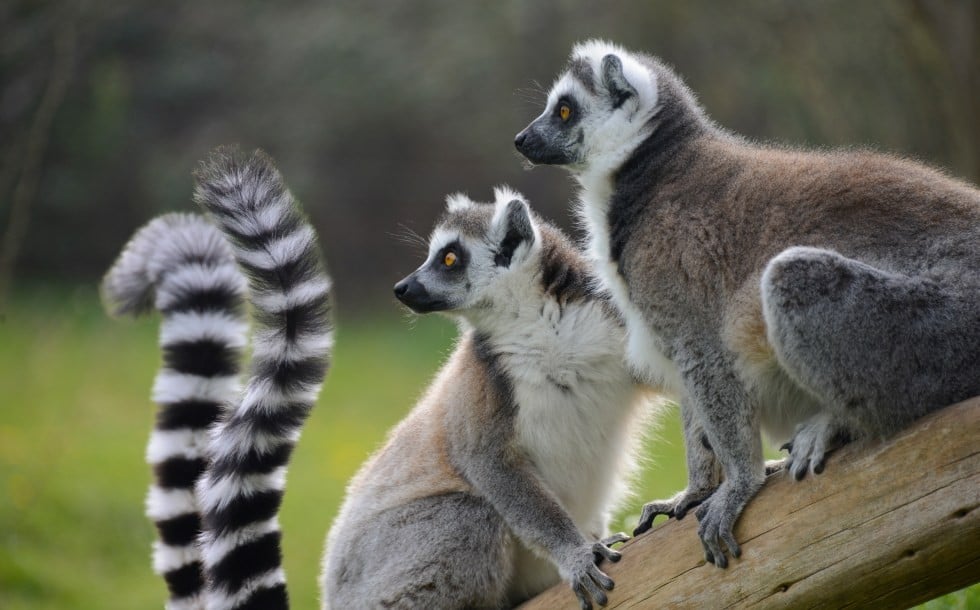
Lemur catta is one of the most iconic primate species hosted in controlled environments worldwide (Figure 1). This research, conducted by Parco Natura Viva and University of Turin in collaboration with European Association of Zoos and Aquaria, provides important insights on the effective management of such an important flagship species, and the findings are applicable and useful to the wide zoo community
Caterina Spiezio – Lemur catta EEP coordinator
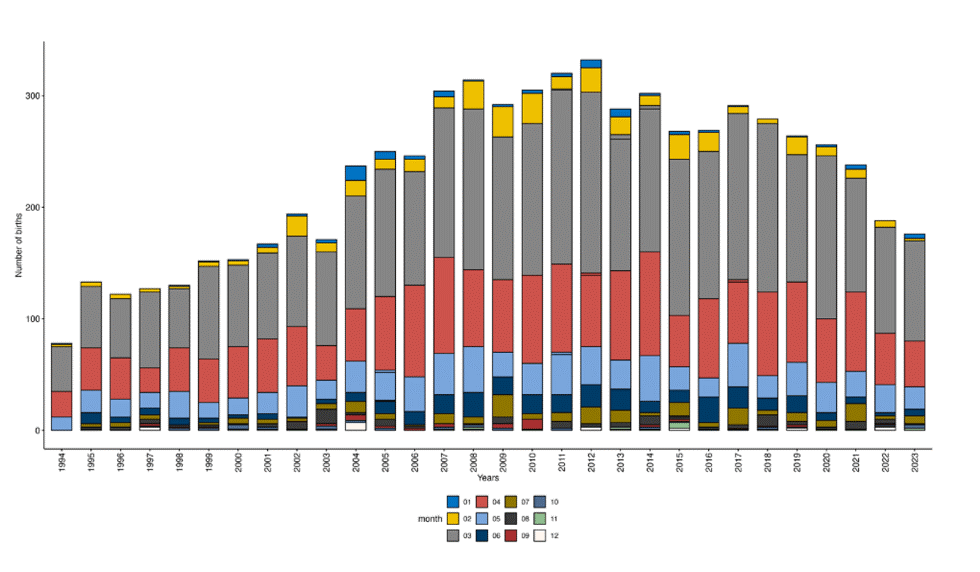
By using data from the ZIMS database, researchers first reviewed the population development along a thirty-year temporal span from 1994 through 2023.
Currently, the living European population of ring-tailed lemurs is composed of 2433 individuals (1306.1006.121), hosted in 232 institutions that are members of Species360.
Across the temporal span 1994-2023 we recorded 7960 total births. Although most of them occurred in March (n=3276, 46.81%), April (n=1987, 24.96%) and May (n=910, 11.43%), there are also births occurring in February (n=373, 4.68%), during summer months (June: n=383, 4.81%; July: n= 226, 2.83%; August: n=115, 1.44%) and in January (n=102; 1.28%). Births seldom occurred even in autumn and winter months (September: n=45, 0.56%; October: n=42, 0.53%; November: n=18, 0.23%; December: n= 33, 0.41%) (Figure 1).
This is the first indication that the species can potentially breed over a longer temporal span than previously thought
Daria Valente, co-coordinator
In addition, the researchers compared the ZIMS data with literature on wild animals to determine whether and how ex situ conservation impacts demographic and life-history patterns. Lemur catta is a strictly seasonal breeder in the wild, where births are concentrated over a brief temporal span of few weeks, peaking in September (coinciding with austral spring). In line with this, also most births in our sample occurred during boreal spring. However, although the interval between the first and the last birth within a year (averaged per zoological institution) is 7.14 weeks, it can also last up to 50.53 weeks.
Findings from ZIMS data show that Lemur catta seems a species able to cope with environmental changes over long time span. This gives hope for the conservation of the species in the wild.
If you would like to learn more about using ZIMS data for research, please take a look at our research requests document.